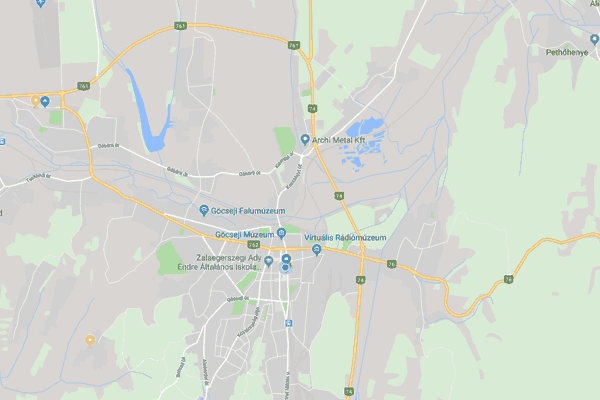
Start your walk before the Göcseji Museum (4).
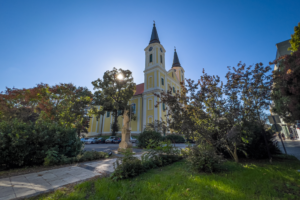
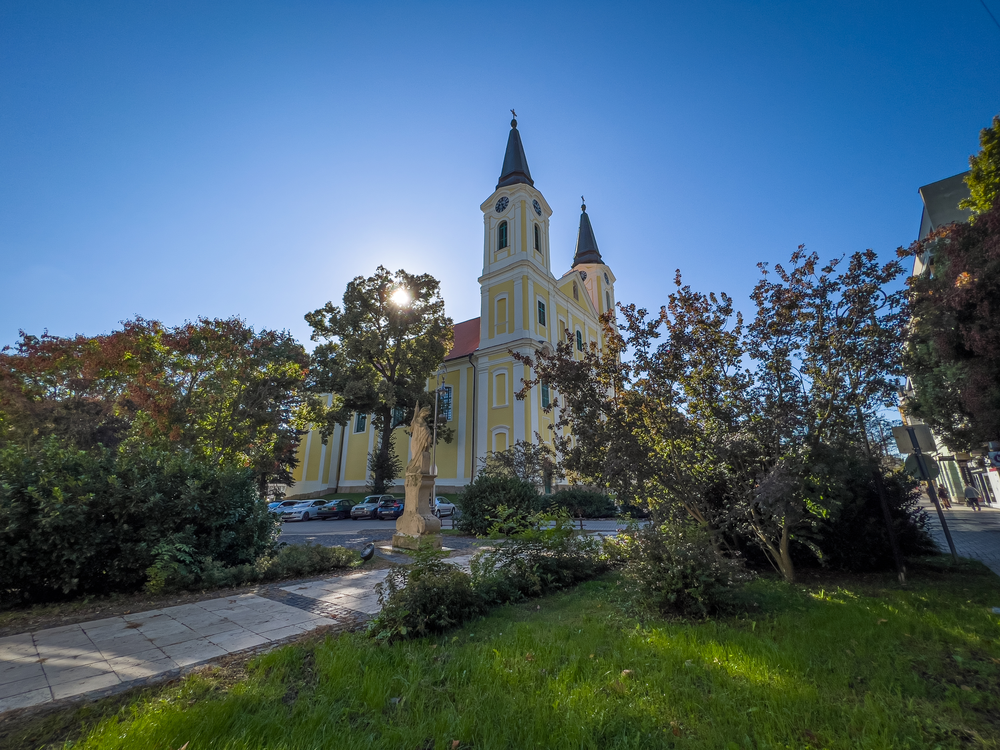
On the high altar of the nearby Mary Magdalene Parish Church (6) there are two locations where initials from the master fresco painter Johann Ignaz Cimbal (1722-1795) can be seen: one of them has just recently been revealed during the church’s restoration and is hidden behind the altar while the other is in the monumental fresco in a section of the rock. A stroll of a couple of minutes takes you to Deák Square, (5) then Piac (Market) Square (16).
Centuries ago the castle of Zalaegerszeg stood here and in today’s Piac (Market) Square white stones indicate where one of the bastions of the castle was discovered. In Széchenyi Square (17) there stands the building housing the Zala County Archives (18), where the oldest general assembly meeting minutes of the present Hungary are kept. Look up and see Zalaegerszeg’s Postal Palace (68) a grandiose three-storey building, but it is not only its wonderful Art Nouveau style that attracts attention: its façade – similarly to the Postal Palace in Pécs – is decorated with Zsolnay ceramics.
Fun facts
In the Lajos Kossuth Street, opposite the Dísz Square, the residential building next to the city hall looks like an ordinary block of flats at first glance, but have a closer look at the balconies and it is obvious why this house is referred to as ‘the whale-balconied house’ (66).
The Csipkeházak (Lace Houses) (26) are among the notable buildings of Zalaegerszeg: the multi-storey residential buildings erected in several phases between 1976 and 1985 are also famous for their balconies: the general effect of the white or dark blue balcony railings creates a wavy façade imitating lacework.
Not far from the Dísz Square (25), in László Csány Square (33) there stands the neo-Gothic Evangelical Church (36), with exceptional internal wall paintings. Peek inside and discover a real rarity: an Angster organ, which has although been mechanically transformed, is still operational. The church can be visited upon prior arrangement.
Moving on, the Kálvária kápolna (Calvary Chapel) (39) can be seen on the small hill next to Rózsák tere (The Square of Roses) (38). Pay respects in the ancient cemetery where you can find one of the oldest gravestones in Egerszeg, the sandstone tomb of János Gothard bootmaker. In Május 1 liget (First of May park) (67) there is a monument in reference to the traditions of Easter perambulation.
Fun Facts
Easter perambulation was a long-standing tradition in our city. At night a group of lads recruited from Zalaegerszeg perambulated the boundaries of the city and its vineyards with pipes and trumpets and other tools to make noise.